
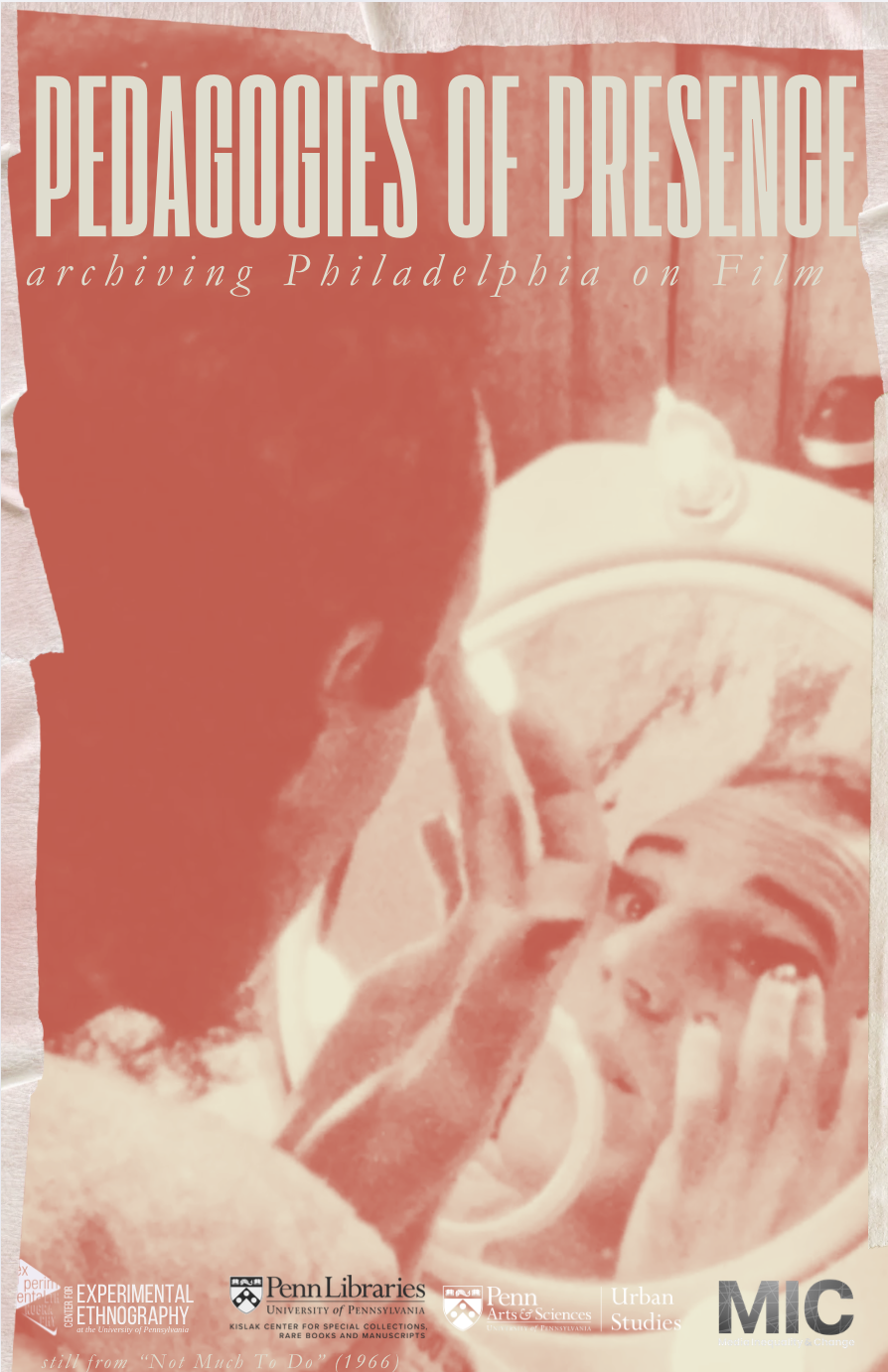
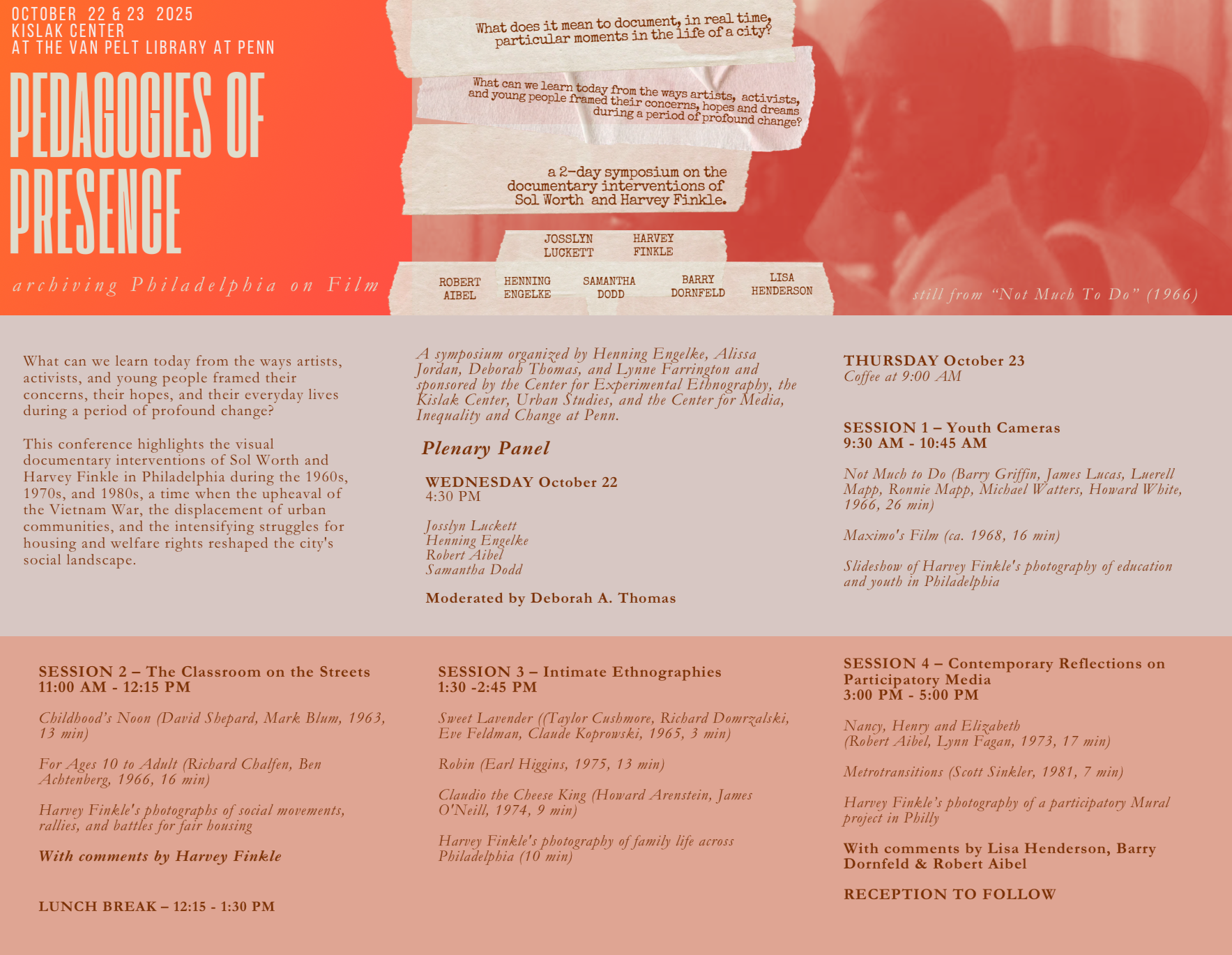
Pedagogies of presence // ArCHIVING PHILADELPHIA ON FILM
A symposium organized by Henning Engelke, Alissa Jordan, Deborah Thomas, and Lynne Farrington and sponsored by the Center for Experimental Ethnography, the Kislak Center, the Urban Studies Program, and the Center for Media, Inequality, and Change at Penn.
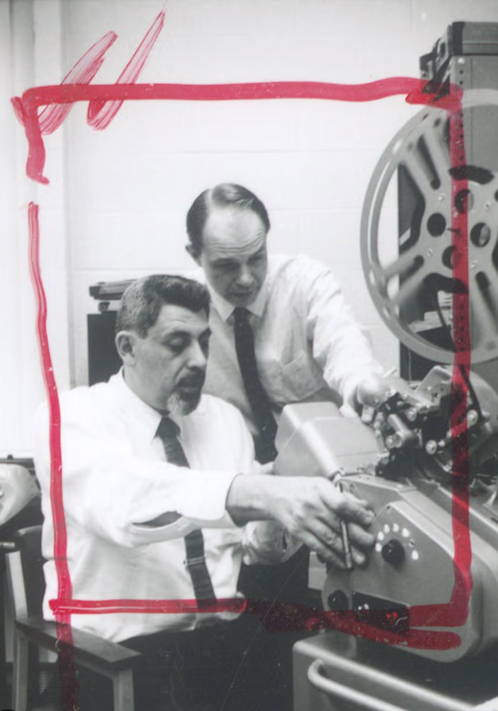
CLASSROOM ON THE STREET
What does it mean to document, in real time, particular moments in the life of a city? What can we learn today from the ways artists, activists, and young people framed their concerns, their hopes, and their everyday lives during a period of profound change? Pedagogies of Presence highlights the visual documentary interventions of Sol Worth and Harvey Finkle in Philadelphia during the 1960s, 1970s, and 1980s, a time when the upheaval of the Vietnam War, the displacement of urban communities, and the intensifying struggles for housing and welfare rights reshaped the city’s social landscape.
Sol Worth is best known for the 1966 project “Navajo Film Themselves,” conducted with the anthropologist John Adair. The project and the resulting book, Through Navajo Eyes(1972), were widely, if controversially, regarded as groundbreaking contributions to visual anthropology. This project was embedded in the broader context of film andcommunication research and teaching at the University of Pennsylvania’s Annenberg School for Communication, where Worth directed the Documentary Film Lab.
During this same moment, social worker Harvey Finkle began using his camera to document the everyday lives of people in the city. Educated at Penn, Finkle became a lifelong advocate for social justice in Philadelphia, and he continues to engage with and document the struggles for justice throughout the city.
While participatory visual methodologies like video elicitation and photo-voice are now commonplace across humanities and social research, they were revolutionary during Worth and Finkle’s era. Worth’s insistence on democratizing representation was part of a profound, and continuing, epistemological shift in the academy. This conference will introduce participants to the archives developed from Worth and Finkle’s projects while examining the broader landscape of participatory visual media in Philadelphia.



Wednesday october 22nd
PANELISTS
Josslyn Luckett
Robert Aibel Henning Engelke
Samantha Dodd
MODERATOR
Deborah Thomas
THURSDAY OCTOBER 23
FILMS
Not Much to Do (Barry Griffin, James Lucas, Luerell Mapp, Ronnie Mapp, Michael Watters, Howard White, 1966, 26 min)
Maximo's Film (ca. 1968, 16 min)
PHOTOGRAPHY
Harvey Finkle's photography of educational and youth projects in Philadelphia 1970-2005 (11 min)
SESSIOn 1 - YOUTH CAMERAS
9:30 aM - 10:45 AM
FILMS
Childhood’s Noon (David Shepard, Mark Blum, 1963, 13 min)
For Ages 10 to Adult (Richard Chalfen, Ben Achtenberg, 1966, 16 min)
Maximo's Film (ca. 1968, 16 min)
PHOTOGRAPHY
Work on rallies and campaigns for the rights or working people and unhoused persons (14 min)
SESSION 2 – The Classroom on the Streets 11:00 AM - 12:15 PM
with comments by Harvey Finkle
FILMS
Sweet Lavender ((Taylor Cushmore, Richard Domrzalski, Eve Feldman, Claude Koprowski, 1965, 3 min)
Robin (Earl Higgins, 1975, 13 min)
Claudio the Cheese King (Howard Arenstein, James O'Neill, 1974, 9 min)
PHOTOGRAPHY
Work on families, homes, and immigrant relocation programs by Harvey Finkle (11 min)
FILMS
Sweet Lavender ((Taylor Cushmore, Richard Domrzalski, Eve Feldman, Claude Koprowski, 1965, 3 min)
Robin (Earl Higgins, 1975, 13 min)
Claudio the Cheese King (Howard Arenstein, James O'Neill, 1974, 9 min)
PHOTOGRAPHY
Work on families, homes, and immigrant relocation programs by Harvey Finkle (11 min)
PEDAGOGIES OF PRESENCE PLENARY PANEL 4:30 PM
SESSION 3 – INTIMATE Ethnographies 1:30 -2:45 PM
SESSION 4 – Contemporary Reflections on Participatory Media 3:00 PM - 5:00 PM
with comments by Barry Dornfeld, Robert Aibel, Lisa Henderson
PRINT MATERIALS

FILMS SCREENED
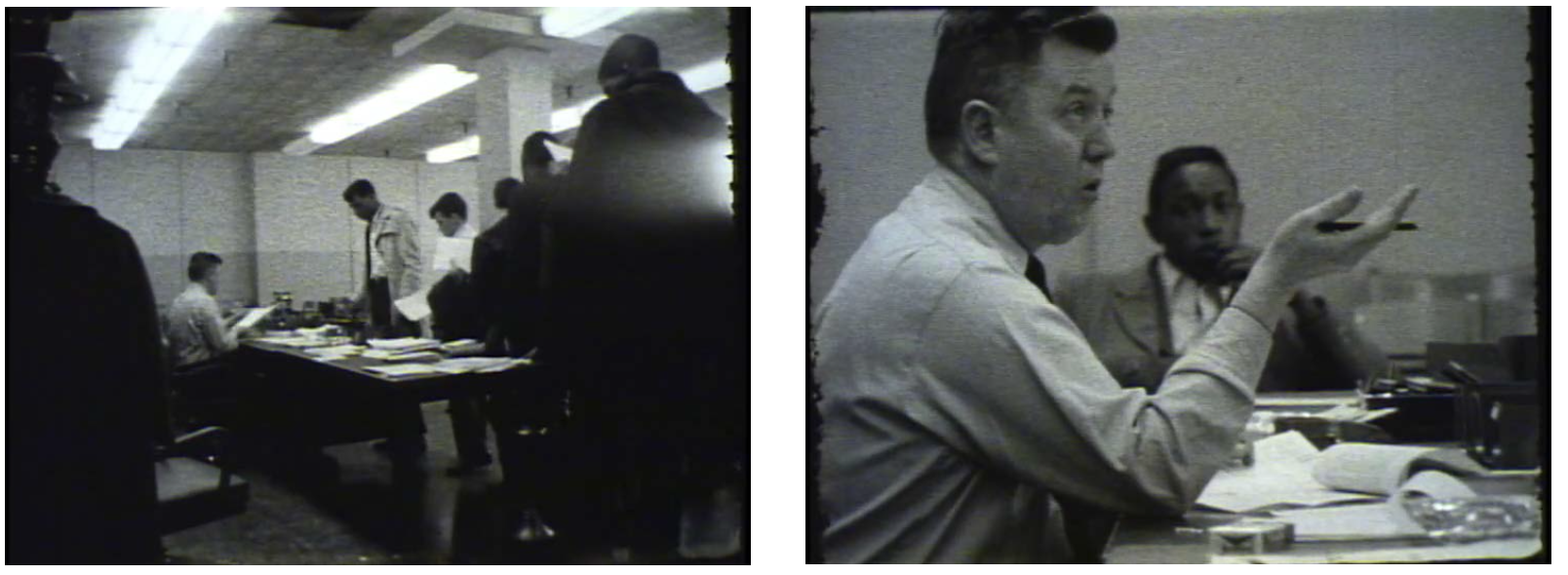
FOR AGES 10 to ADULT // 1966
Anti-war film, “exploration of the draft”, filmed at draft board and induction center in Philadelphia. Combining footage shot at the draft board and induction center in Philadelphia with scenes of children playing with military toys, this film examines the “machinery for delivering young men to the military”.
CREATOR
Ben Achtenberg, Richard Chalfen
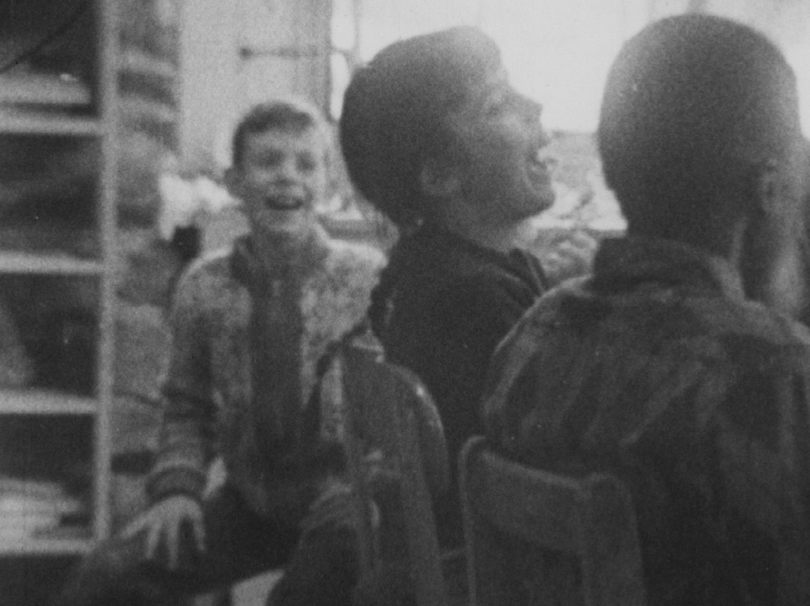
Childhood’s Noon // 1963
Children’s games and fairy tales as “preparation for adulthood.” This film shows a group of children aged 8 to 10 from a racially integrated elementary school at play in a succession of games. Reflecting on the process of growing up, the film also confronts racist prejudices.
CREATOR
David Shepard, Mark Blum
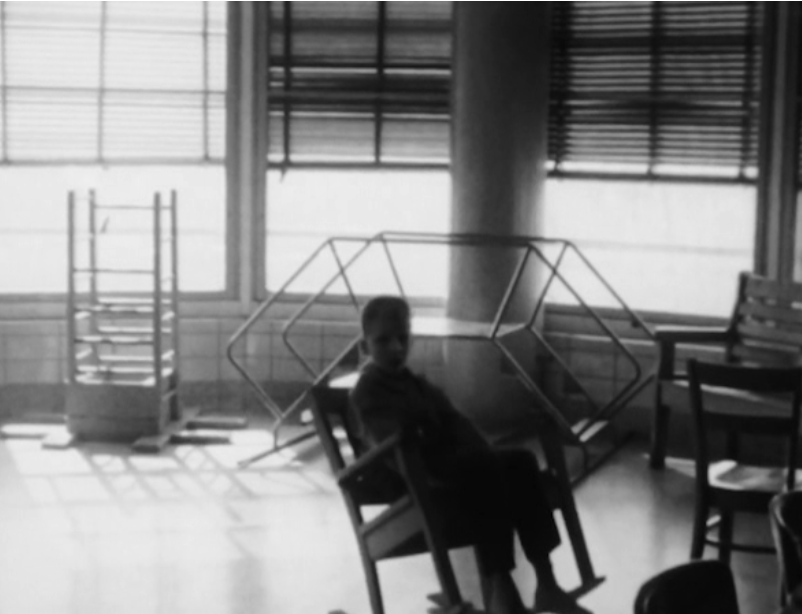
WALLS OF SKIN // 1964
A film about an autistic boy filmed at the Eastern Pennsylvania Psychiatric Institute. Depicting the conditions of the boy’s institutionalization, the film identifies with the perspective of the child.
CREATOR:
Rita Mitra, Martin Spinelli, Arthur Plutzer
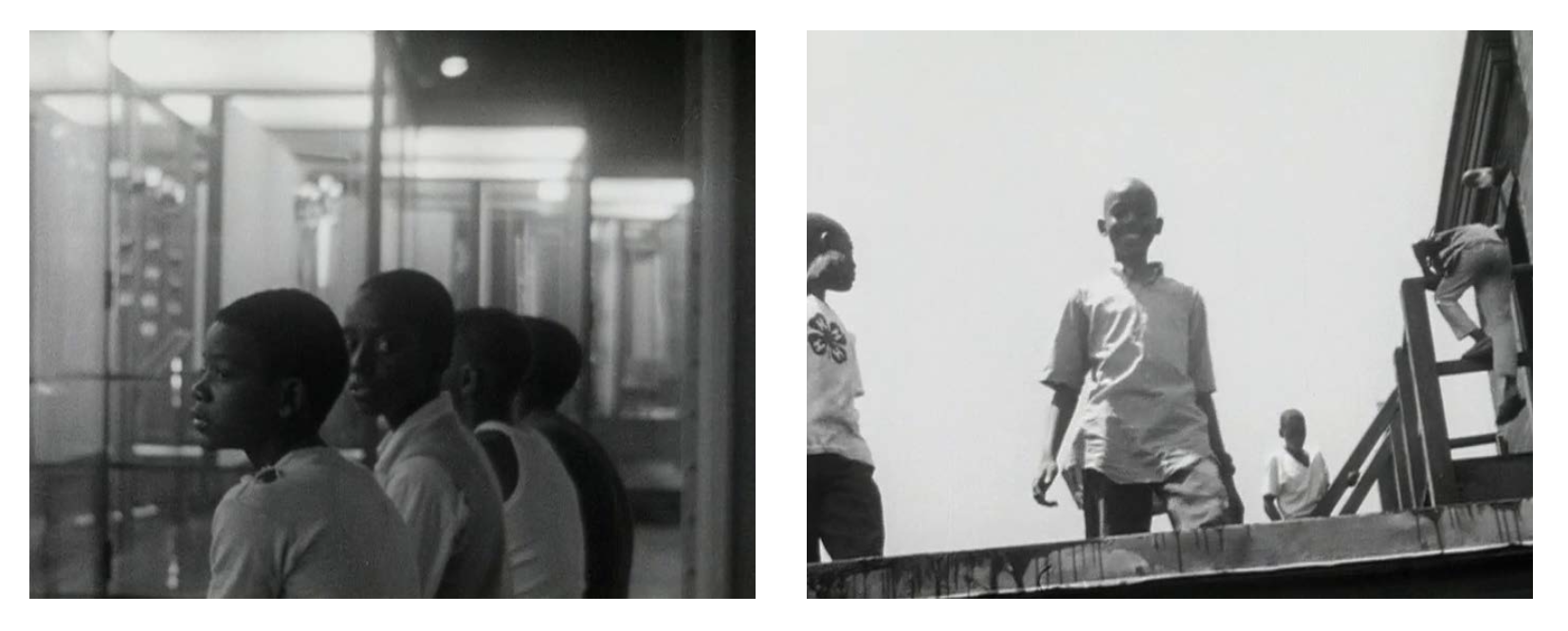
NOT MUCH TO DO // 1966
A film made by African American teenagers from an inner-city neighborhood in Philadelphia marked for “urban renwal” about their search for fun and adventure to fill the long summer days. The film was sponsored by the Tabernacle Presbyterian Church and supervised by Ben Achtenberg.
MAXIMO'S FILM // 1968
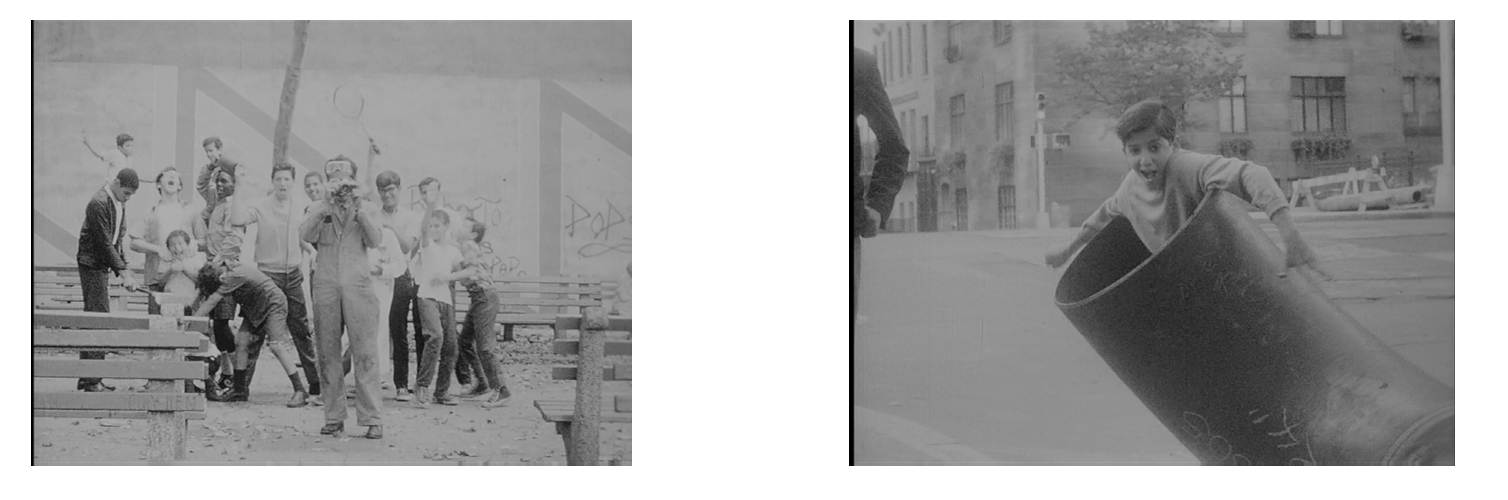
Made by a fifteen-year-old Puerto Rican/African American boy at Mount Sinai Hospital in New York, the film combines a heist story with scenes of youth playing and fooling around in East Harlem. The filmmaker also experiments with various camera and editing techniques.
Sweet Lavender // 1965
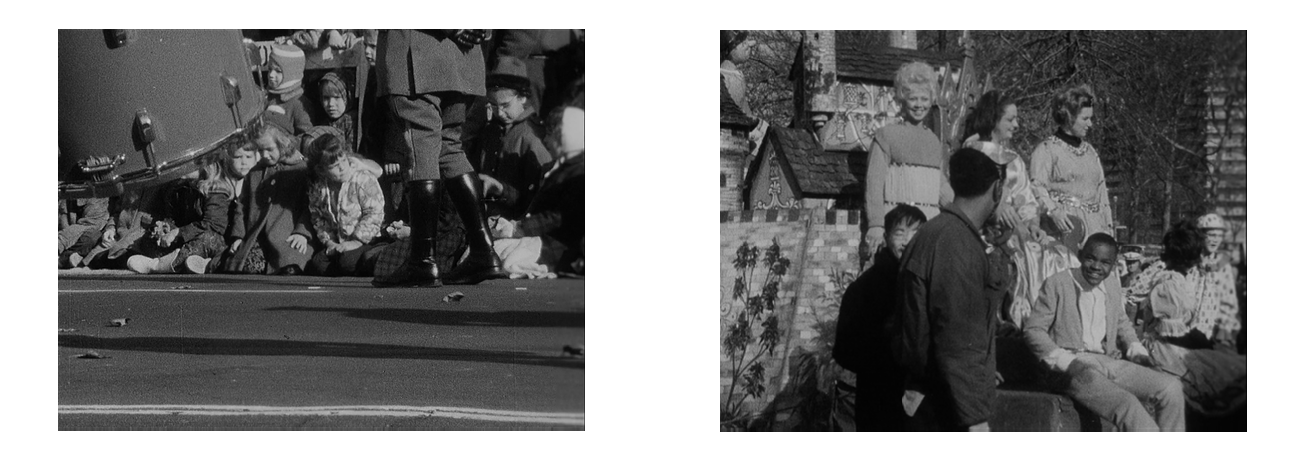
“A film about withdrawal and desertion,” focusing on a woman who sells lavender sachets In Philadelphia’s Center City area. Includes shots of a parade on Benjamin Franklin Avenue
CREATOR
Taylor Cushmore, Richard Domrzalski, Eve Feldman, Claude Koprowski