
THE ASYLUM COMPANY
Young, Cory James. “Finding Asylum: Slavery, Freedom, and Legacy in Northern Pennsylvania.” The Journal of African American History 109, no. 4 (2024): https://doi.org/10.1086/732121.
-
Pennsylvania Gradual Abolition Act (1 March 1780)
Pennsylvania enacts the Act for the Gradual Abolition of Slavery. Children born after this date to enslaved mothers serve only until age twenty-eight. Non-resident owners may keep enslaved people in the state no longer than six months; longer residence frees them. A 1788 amendment closes loopholes. This framework later shapes every legal claim involving enslaved people at Azilum. (Young 2024)
-
Open Entry for White Immigrants (1790s)
The United States of the 1790s treated the arrival of free white foreigners as a normal and largely unrestricted occurrence. There were no federal visas, passports, quotas, or formal immigration controls. Anyone who reached an American port could land and settle. French émigrés and Saint-Domingue refugees therefore entered freely as private individuals.
Once in the United States, many of these newcomers cultivated a distinct refugee identity. Planters and nobles who had fled revolution and slave uprising petitioned the Pennsylvania legislature for special relief, arguing that, like American war refugees in 1781, they should be allowed to retain the people they held in bondage. The assembly rejected those requests. This moment is treated in historical literature as an early chapter in the American self-image as a place of asylum—though the welcome was extended primarily to white refugees and remained in tension with Pennsylvania’s anti-slavery law. (Young 2024)
-
Nicholson Acquires Wyoming Lands (1780s–1790)
John Nicholson, as Comptroller General, acquires Wyoming Valley lands that later form part of Asylum Company holdings. A 1790 law reaffirms the Decree of Trenton and validates Pennsylvania titles. (Arbuckle 1972)
-
French Revolution Begins (1789)
The French Revolution begins. The Declaration of the Rights of Man and of the Citizen is issued.
-
Haitian Revolution Begins (August 1791)
The slave uprising in Saint-Domingue begins, launching the Haitian Revolution. White planters and royalist nobles from France and the Caribbean begin seeking refuge in the United States, especially Philadelphia.
-
Execution of Louis XVI (21 January 1793)
Louis XVI is executed in Paris.
-
Refugees Flood Philadelphia (Summer–Autumn 1793)
Large numbers of French and Saint-Domingue refugees reach Philadelphia amid the yellow-fever epidemic. Private subscriptions raise nearly $14,000 for relief. Many of the newcomers, raised on Enlightenment images of America and on accounts such as Crevecoeur’s Letters from an American Farmer, begin to imagine a quieter, self-contained rural community far from the disease, politics, and expense of the city. The desire to leave Philadelphia and recreate a controlled aristocratic life in the wilderness is part of what drives the Azilum project.
-
Land Purchased for Azilum (Late 1793)
Robert Morris and John Nicholson, with French agents including the Vicomte de Noailles and Antoine Omer Talon, arrange purchase of roughly 1,600 acres on a horseshoe bend of the Susquehanna. Agents Charles Bué Boulogne and Adam Hoops select the site. The project is framed as a refuge—an “asylum”—where the exiles can live according to their own habits, safely removed from both European upheaval and the disorder of Philadelphia. (Sarsfield 1973; Arbuckle 1972)
-
Dual Land Titles Secured (Late 1793)
The French insist on securing both Pennsylvania and Connecticut titles. Matthias Hollenback is charged with procuring Connecticut claims and pays out of pocket for lots. (Arbuckle 1972)
-
First Settlers Arrive (1793)
First parties of settlers arrive by Durham boat and canoe. Building materials are shipped upriver from Wilkes-Barre. Early petitions seeking exemption from the six-month rule are opposed by the Pennsylvania Abolition Society and rejected. Houses are later built on the river bank for enslaved people. (Sarsfield 1973; Young 2024; Afrolumens)
-
Execution of Marie Antoinette (16 October 1793)
Marie Antoinette is executed. News reaches Pennsylvania; near the future site of Azilum an innkeeper erects a sign depicting a decapitated woman labeled “The Guillotined Queen of France.” (Arbuckle 1972)
-
Birth of Asylum Peters (1793)
Asylum Peters, the first recorded child born at French Azilum, is born to enslaved parents from Saint-Domingue. Under the 1780 Gradual Abolition Act he should have been born free (his mother could not be legally held beyond six months), yet he is treated as enslaved, bought, sold, and denied education. He is named for the settlement itself. (Young 2024)
-
Emergency Funds for French Slaveholders Fleeing the Ashes of Colonial Elsewheres (12 February 1794)
On 12 February 1794, President George Washington signed “An Act providing for the relief of such of the inhabitants of Santo Domingo, resident within the United States, as may be found in want of support.” Congress appropriated up to $15,000 for their relief, to be distributed under the President’s direction and provisionally charged against the American debt to France.
The process began with a Maryland petition describing the arrivals as having been “driven from St Domingo by the Savage Barbarity of the People of Colour.” In the House debate, members spoke of “fugitives,” “distress,” and “scenes of distress,” and invoked American obligations to France. They did not dwell at length on the slave uprising as the central cause. Private letters and local memorials in Baltimore, Philadelphia, and elsewhere more openly referred to the violence of the “people of colour” or the “horrors” of Saint-Domingue.
-
Boulogne’s Supply Letter (30 April 1794)
Charles Boulogne writes Hollenback listing urgent shortages of iron, nails, tools, livestock, and canoes, documenting the settlement’s dependence on external suppliers. (Sarsfield 1973)
-
Town Laid Out as Parallelogram (April–Spring 1794)
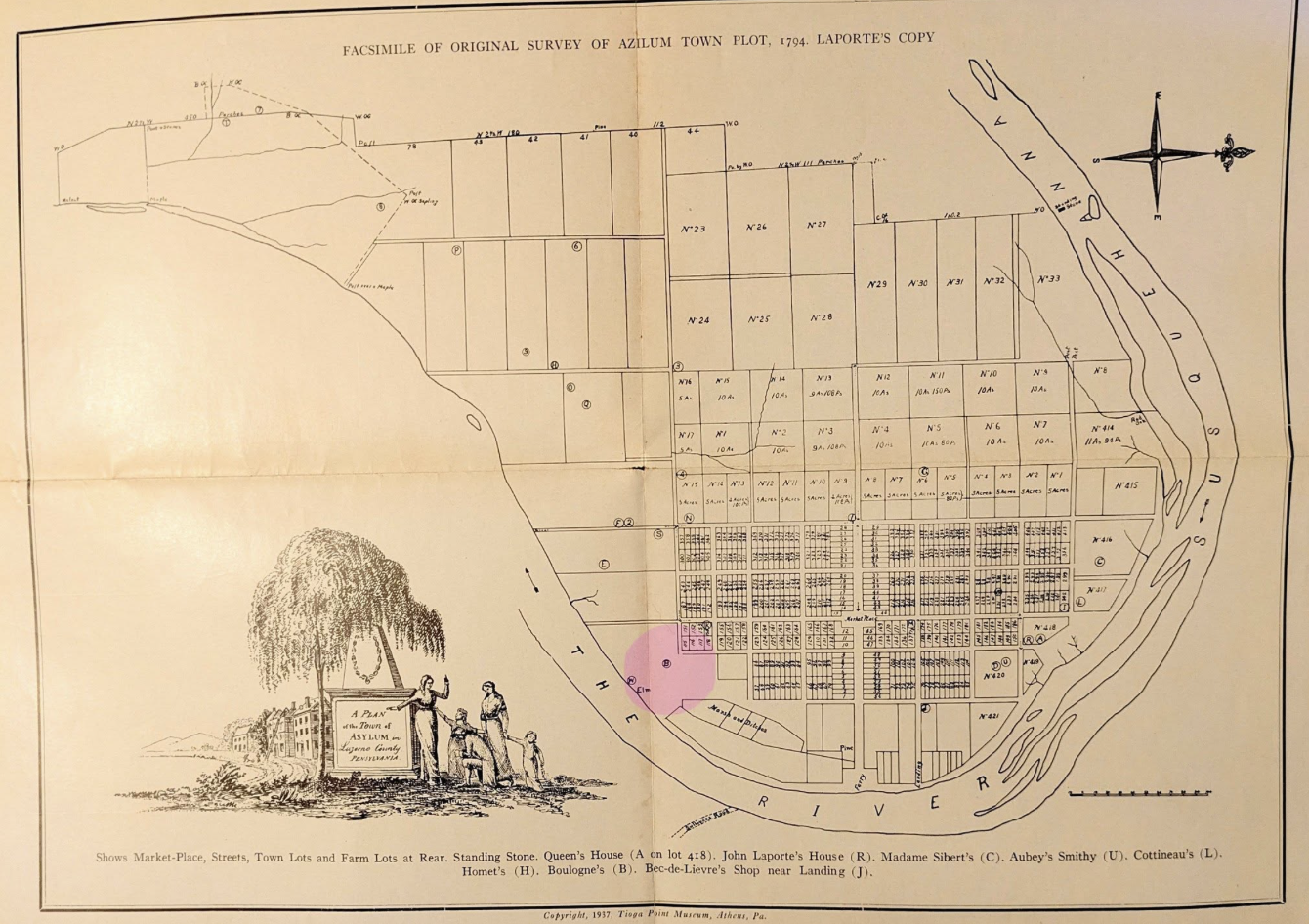
The Plan of Association of the Asylum Company is signed. The town is laid out as a parallelogram with five north–south streets and nine east–west streets, 413 half-acre lots, and a central market square. (Arbuckle 1972; Sarsfield 1973)
-
Grande Maison Under Construction (Spring–Summer 1794)
Construction of La Grande Maison begins. By this period the settlement has forty to fifty houses, inns, shops, a chapel, a theater, a blacksmith shop, and a bakery. Enslaved and formerly enslaved labor supports clearing, building, and domestic work. (Arbuckle 1972; Young 2024)
-
Talleyrand Visits Azilum (1794)
Talleyrand visits Azilum and finds only about forty inhabitants. He warns American speculators not to rely on French émigrés to clear the forests. (Arbuckle 1972)
-
Commonwealth v. Chambre Decision (September 1794)
Pennsylvania Supreme Court decides Commonwealth v. Chambre, holding that “six months” means calendar months and remanding two women to service. The case becomes a key precedent for how the Gradual Abolition Act applied to French and Caribbean refugees.
-
Rochefoucauld-Liancourt Visits (May 1795)
The Duc de la Rochefoucauld-Liancourt spends nearly twelve days at Azilum. He notes physician M. Buzard settled “with his wife, daughter, and son, and some negroes, the remains of his fortune,” as well as other Saint-Domingue planters and merchants who arrived with property and enslaved people. (Young 2024)
-
Hollenback Demands Payment (May 1795)
Hollenback, still unpaid for advances on Connecticut titles, writes Morris and Nicholson demanding payment and threatening suit. (Arbuckle 1972)
-
Pennsylvania Titles Confirmed (13 May 1795)
Pennsylvania District Court decides Vanhorne’s Lessee v. Dorrance, confirming Pennsylvania titles against Connecticut claims. Nicholson later buys remaining Connecticut rights for £2,000. (Arbuckle 1972)
-
Noailles Manumits and Indentures (Late 1795)
Lewis Guy de Noailles manumits three children (Figaro, Antoine, Victoria) whom he had enslaved in Saint-Domingue and indentures them until age twenty-eight. Two years later he transforms twelve-year-old Comte from a slave for life into a house servant for sixteen years. Pennsylvania courts repeatedly affirm the legality of converting lifetime slavery into term servitude. (Young 2024)
-
Escape of Unnamed Man (1 April 1796)
M. Laroue writes Matthias Hollenback from Asylum reporting that a Black man about twenty years old has run away with a new axe and clothing. The man “says he is free, though he is bound for no less than fourteen years.” Laroue offers a reward and asks Hollenback to advertise the escape. The incident illustrates both the informal character of bondage at Azilum and the practice of petit marronage. (Young 2024; Afrolumens)
-
Death of Charles Boulogne (1796)
Charles Boulogne drowns near Asylum. His widow appeals to Nicholson for assistance. (Arbuckle 1972)
-
Nicholson Takes Control (1795–1796)
Morris sells his shares to Nicholson. Nicholson becomes almost sole proprietor, raises agents’ salaries, finishes the Old French Road, and proposes a college and rural bank. Talon is sent to Europe to sell shares with little success. (Arbuckle 1972)
-
Louis Philippe Visits (1796–1797)
Louis Philippe, Duc d’Orléans (later King of the French), travels through Pennsylvania with his brothers. Local histories place them at Azilum; they are also entertained by Hollenback in Wilkes-Barre. Peak population is estimated between roughly one hundred and two hundred fifty. (Sarsfield 1973)
-
Labor on Improved Lots (December 1797)
Descriptions of improved village lots make clear the scale of labor required. Enslaved and formerly enslaved adults and children performed much of this work. (Young 2024)
-
Birth of Oneïda de Blacons (17 May 1798)
Marie Magdeleine Adélaïde Alexandrine Onéïda d’Armand de la Forest de Blacons is born at French Azilum to the Marquis de Blacons and Félicité de Maulde. The name Onéïda is given in recognition of the Oneida Nation and the American setting. She later marries Louis-Marie-Antoine-Auguste-Fortuné d’Andigné in Paris in 1818.
-
Birth of John LaPorte (4 November 1798)
John LaPorte, only child of Bartholomew LaPorte and Elizabeth Franklin, is born at Asylum. He later becomes Surveyor General of Pennsylvania and Speaker of the Pennsylvania House. His 1836 brick house still stands at the site.
-
Paul and Point Dujour Escape (5 November 1799)
Paul and Point Dujour escape from physician M. Buzard of Azilum. Buzard places a two-dollar reward advertisement in Wilkes-Barre papers. Both had been brought from Saint-Domingue and were legally free after six months under Pennsylvania law. (Afrolumens; Young 2024)
-
Brevost Holds Asylum Peters (1800)
Federal census lists a single enslaved person in the household of John Claudius Brevost at Azilum—almost certainly the young Asylum Peters. (Young 2024)
-
Brevost Plans French Academy (1801)
John Brevost announces intent to found a French-language academy at Azilum. The colony is already collapsing as investors withdraw capital. (Young 2024)
-
Azilum Becomes a Ghost Town (c. 1802–1805)
Azilum is largely abandoned. Most of the French residents return to France under Napoleonic amnesty, move to other American cities, or die. By about 1805 the settlement is for all practical purposes a ghost town—one of the earliest planned communities in the United States to fail so completely and leave almost no permanent population. The Brevost family relocates to Philadelphia, taking Asylum Peters with them. (Sarsfield 1973; Young 2024; Arbuckle 1972)
-
Brevost Moves North with Peters (Late 1805–1806)
Governor Thomas McKean appoints John Brevost a trustee of the newly formed McKean County. Brevost returns north to the Ceres settlement, taking thirteen-year-old Asylum Peters with him. (Young 2024)
-
Sale of Asylum Peters (March 1808)
John Brevost sells Asylum Peters to William Ayers for $100, with a promise of schooling and freedom at age twenty-one. Ayers brings Peters to a farm near Coudersport in Potter County. Peters later leaves Ayers before the term ends and settles with the Edgecomb family. (Young 2024; Afrolumens)
-
Peters Lives as Free Man (c. 1809–1880)
Asylum Peters lives as a free man in Potter County for more than sixty years—farming, road-building, hunting, and transmitting local historical knowledge. He is the only (or one of very few) Black residents of the county for decades. (Young 2024)
-
Asylum Township Created (1814)
Asylum Township is formed from Wyalusing and named in honor of the French refugees.
-
Death of Asylum Peters (24 November 1880)
Asylum Peters dies at about age 87. Obituaries describe him (incorrectly) as the only person “lawfully a slave” ever owned in the county and as “the only colored person in the county.” One obituary transposes his name to “Peter Asylum.” (Young 2024)
-
Headstone Erected by DAC (25 July 1956)
The Coudersport branch of the Daughters of the American Colonists erects a granite headstone on Peters’s previously unmarked grave. The inscription reads “Peter Asylum, 1793–1880, Colored Slave Brought by Wm. Ayers 1808,” perpetuating both the name error and the characterization of him as a slave rather than a free man for most of his long life. (Young 2024)
-
Site Revitalized as Historic Park (1953–present)
The site is revitalized as a historic and archaeological area under French Azilum, Inc.
KEY SOURCES…
Arbuckle, Robert D. John Nicholson, 1757–1800: A Case Study of an Early American Entrepreneur. PhD diss., Pennsylvania State University, 1972. ProQuest (302602768). https://www.proquest.com/dissertations-theses/john-nicholson-1757-1800-case-study-early/docview/302602768/se-2.
“Enslavement in Pennsylvania: Bradford County – Enslaved Persons of the Azylum Settlement, 1793–1807.” Afrolumens Project. https://afrolumens.com/slavery/azylum.html.
Finkelman, Paul. “The Law of Slavery and Freedom in Pennsylvania.” Duquesne Law Review (analysis of Commonwealth v. Chambre). https://sites.law.duq.edu/lawreview/wp-content/uploads/2017/08/Finkelman-4531.pdf.
Murray, Louise Welles. The Story of Some French Refugees and Their “Azilum,” 1793–1800. Athens, PA, 1903.
Sarsfield, Robert. Matthias Hollenback and the Early Wyoming Valley. PhD diss., 1973. ProQuest (302691452). https://www.proquest.com/dissertations-theses/matthias-hollenback-early-wyoming-valley/docview/302691452/se-2.
United States. “An Act providing for the relief of such of the inhabitants of Santo Domingo, resident within the United States, as may be found in want of support.” Statutes at Large 6 (12 February 1794): 13.
Young, Cory James. “Finding Asylum: Slavery, Freedom, and Legacy in Northern Pennsylvania.” The Journal of African American History 109, no. 4 (2024). https://doi.org/10.1086/732121.
Ancestry.com. Profile of Amédée Marie Alexandre d’Andigné (and mother Marie Magdeleine Adélaïde Alexandrine Onéïda d’Armand de la Forest de Blacons). https://www.ancestry.com/genealogy/records/amédée-marie-alexandre-d-andigné-24-fkvdm0.
Founders Online (National Archives). Congressional debates and executive correspondence on Santo Domingan refugees, January–February 1794 (Madison, Washington, Randolph, etc.).